


New Research: When to Deploy Mechanical Circulatory Support in Heart Attack And Shock; And Why Timing Is Everything

Published April 2024 | European Heart Journal: Acute Cardiovascular Care
Cardiogenic shock complicating a heart attack is one of the most time-sensitive, highest-stakes scenarios in cardiovascular medicine. Despite major advances in intensive care and catheterization lab capabilities, mortality remains stubbornly high, around 40% at 30 days and 50% at one year. One of the most debated questions in managing these patients is whether to deploy mechanical circulatory support early or wait. As senior author, Dr. Megaly led a study published in the European Heart Journal: Acute Cardiovascular Care, which addressed this question using one of the largest real-world datasets available.
The Clinical Problem
When a heart attack is complicated by cardiogenic shock, a state in which the heart can no longer pump enough blood to sustain the body, the decision to use temporary mechanical circulatory support (tMCS) devices such as the Impella, intra-aortic balloon pump (IABP), or ECMO is rarely straightforward. These devices can take over or augment cardiac output, buying time for revascularization and recovery. But when to deploy them, and whether earlier is always better, have not been well defined.
What the Study Found
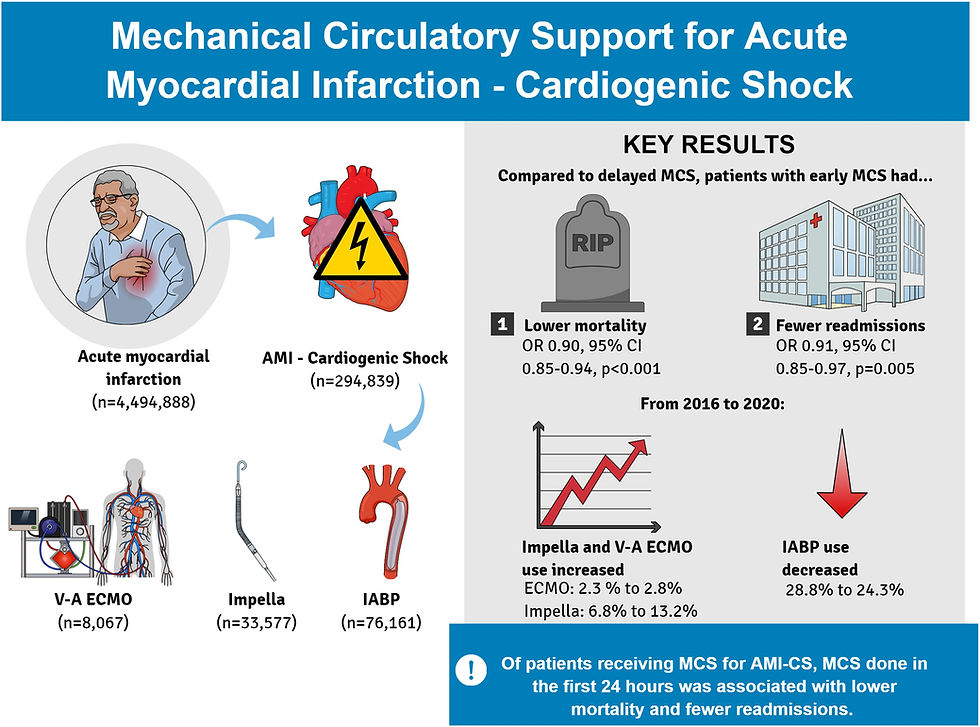
Dr. Megaly and his team analyzed outcomes in over 160,000 patients who suffered a heart attack complicated by cardiogenic shock between 2016 and 2020, using the National Readmissions Database. About 37% required tMCS. Several findings stood out.
First, device use patterns are shifting: Impella utilization nearly doubled over the five-year study period, while IABP use declined, reflecting evolving clinical practice and growing operator experience with higher-support devices.
Second, and most clinically important, among patients who received tMCS, those who received it within 24 hours of admission had meaningfully better outcomes than those whose support was delayed. Early tMCS was associated with lower in-hospital mortality, shorter hospital stays, lower total hospital costs, and fewer readmissions.
Third, the data reinforced that in unselected all-comers with AMI-CS, tMCS did not uniformly improve survival, underscoring that patient selection and timing, not device use alone, drive outcomes.
What This Means for Patients
The clinical takeaway is direct: if tMCS is the right decision for a patient, waiting is not a neutral choice. Delays in deployment, whether driven by diagnostic uncertainty, institutional logistics, or a decision to observe before escalating, appear to carry a real cost in outcomes.
For patients with heart attack and shock, access to a center with experienced operators and the full spectrum of circulatory support devices is not a secondary consideration. It is part of the treatment.
Why This Research Matters
This study adds meaningful real-world evidence to an area where randomized trial data remain limited and often conflicting. As senior investigator, Dr. Megaly designed this work to directly inform how operators approach tMCS timing at the bedside, supporting a proactive, protocol-driven strategy grounded in early risk stratification, multidisciplinary shock team activation, and timely intervention.
Read the full study
Dr. Michael Megaly specializes in complex and high-risk coronary interventions, chronic total occlusion (CTO) PCI, surgical turn-downs, complex peripheral artery disease, and limb salvage at Integris Health Heart Hospital in Oklahoma City.


Comments