


Heart Attack Risk and the Life-Saving Role of Revascularization in Burn Patients, A Nationwide Study Led by Dr. Michael Megaly
- Dr. Michael Megaly

- Feb 2
- 2 min read
Oklahoma City, OK — Burns, 2025
A nationwide study led by Dr. Michael Megaly, as senior author, an interventional cardiologist at Integris Health Heart Hospital in Oklahoma City, examined the incidence, risk factors, and outcomes of myocardial infarction (MI) in patients hospitalized with burn injuries, a critically ill population where cardiac complications are often underrecognized and undertreated.
Published in the journal Burns, the study analyzed the Nationwide Readmissions Database (2016–2020), identified burn hospitalizations across the United States, and compared outcomes between those who developed MI and those who did not.
What the data showed:
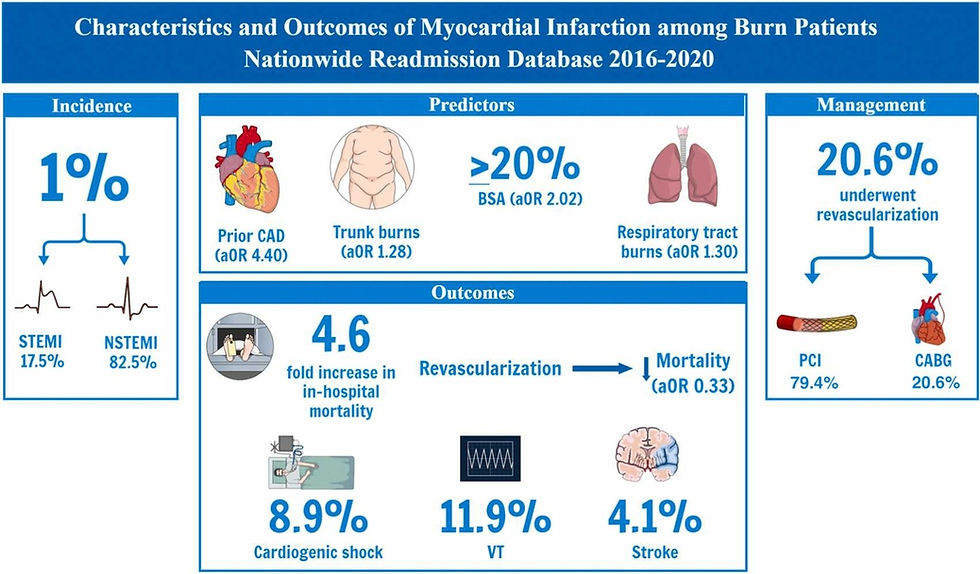
MI occurred in approximately 1% of burn hospitalizations, but when it did, the consequences were severe. Patients with MI had an in-hospital mortality rate of 18.7%, compared to 3% in burn patients without MI, a 4.6-fold increase in adjusted mortality risk (aOR 4.59, 95% CI 3.66–5.76). Rates of cardiogenic shock, ventricular tachycardia, and stroke were also significantly higher in the MI group.
Burns involving the trunk, the respiratory tract, and those affecting more than 20% of total body surface area were independently associated with higher MI risk. Affected patients tended to be older, male, and carrying a greater burden of cardiovascular comorbidities.
The intervention that changed survival:
Among burn patients who suffered an MI, those who underwent coronary revascularization with stenting or bypass surgery had dramatically better outcomes. Revascularization was associated with 67% lower odds of in-hospital death (aOR 0.33, 95% CI 0.17–0.64). In a population with nearly 1-in-5 mortality, that is a clinically decisive difference.
This study reinforces a core principle of complex cardiovascular care: even in the most physiologically hostile environments, timely identification and treatment of the culprit lesion saves lives. The findings add to the evidence base for managing high-risk cardiovascular presentations in critically ill patients, which is the exact clinical terrain Dr. Megaly works in daily.
The full study is published in Burns (2025;51(1):107313). Read the study →
Dr. Michael Megaly specializes in complex and high-risk coronary interventions, chronic total occlusion (CTO) PCI, surgical turn-downs, complex peripheral artery disease, and limb salvage at Integris Health Heart Hospital in Oklahoma City.
Comments